
Skip to content

Trans Freedom School

Explore the histories, ideas, and movements shaping trans life today through our interactive timeline, interviews, and panels featuring scholars, advocates, and healthcare professionals.

  • Costume party at the Institute for Sexual Research in Berlin, Magnus Hirschfeld (in glasses) holds hands with his partner, Karl Giese (center). Date and photographer unknown.
    1897

    The First Organization to Advocate for Sexual Minorities

    Magnus Hirschfeld co-founds the Scientific-Humanitarian Committee– generally seen as the first organization in the world devoted to social reform on behalf of sexual minorities. The organization’s motto was “Per scientiam ad justitiam” (through science to justice).

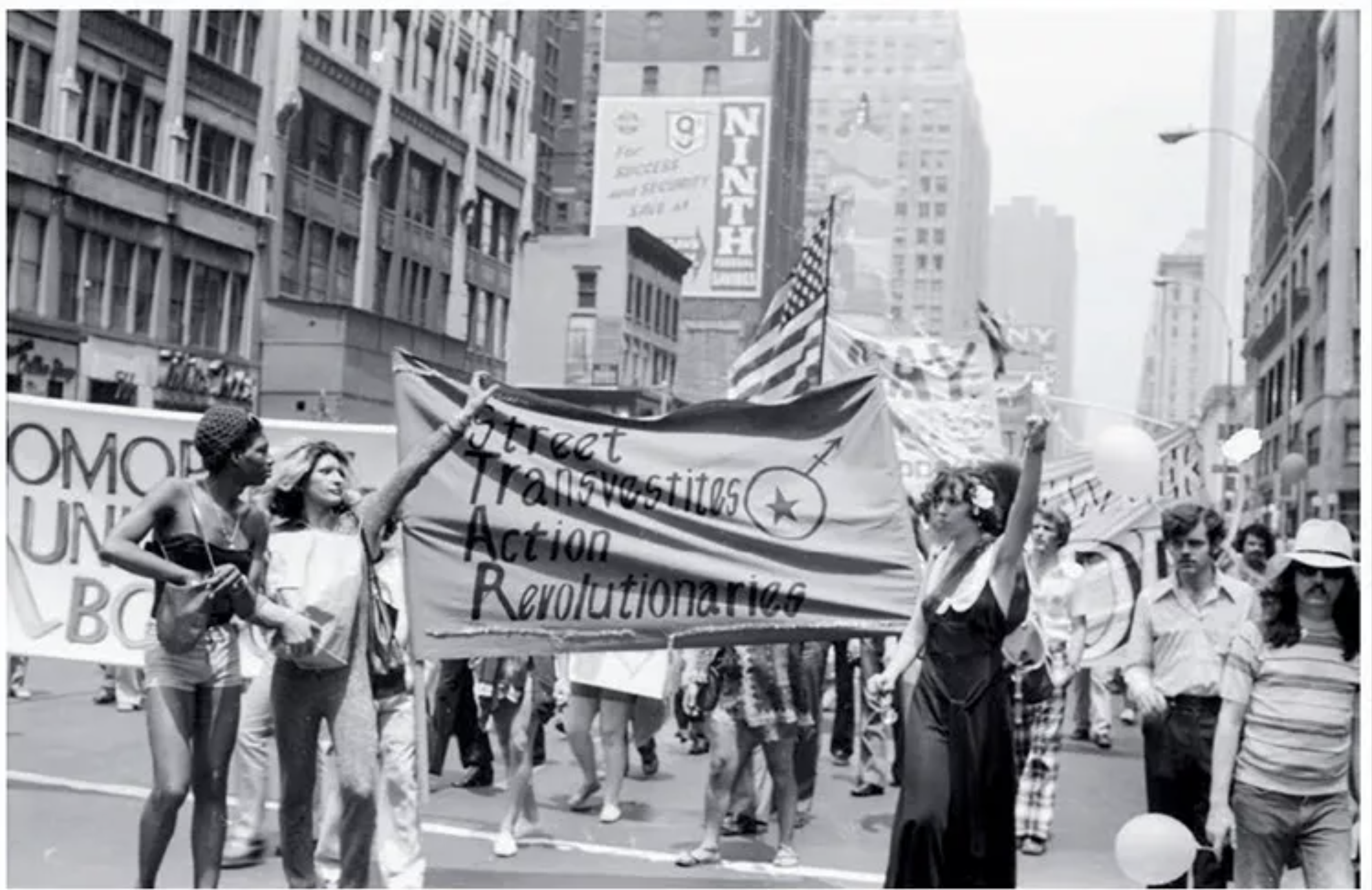
  • Street Transvestite Action Revolutionaries march in the Christopher Street Liberation Day Parade in New York City, June, 1973. Photo by Richard C. Wandel, the LGBT Community Center National History Archive, New York.
    1970

    Sylvia Rivera and Marsha P Johnson establish STAR

    Sylvia Rivera and Marsha P Johnson, both of whom were on the frontlines of Stonewall, establish STAR (Street Transvestite Action Revolutionaries)

  • Monica Helms, creator of the transgender flag, marching in a Pride Parade in 2004.
    2000

    Trans Pride Flag is Revealed

    At a pride parade in Phoenix, Arizona, the Trans Pride flag is shown for the first time.

  • Montana Rep. Zooey Zephyr holding a microphone high above her head with her other hand in a fist against her chest
    2023

    Trans Lawmaker Zooey Zephyr is Censured After Protesting Anti-trans Legislation

    Trans lawmaker and Montana Rep. Zooey Zephyr is censured after protesting anti-trans legislation, and draws national attention.

Freedom Talks

Freedom Talks is a series of conversations with experts exploring issues in trans history, politics, healthcare, law, and culture. These interviews offer research-informed tools for understanding anti-trans movements and challenging misinformation in today’s changing political landscape.

  • What is “Trans Health Care?”

    (21:09) “What does it mean when we are denying, when we are ignoring the knowledge that comes from experience, that comes from living it, that comes from the everyday knowledge of being a trans person, or living with HIV… we have a tendency to listen to people who a lot of times have no experience with any of those things.” – Tankut Atuk

  • What is “Trans Health Care?”

    In “What is trans healthcare?,” scholars Tankut Atuk and Ruth Pearce discuss the myriad of ways that people conceptualize trans health and healthcare, from trans activists on the front lines to public health officials at the highest level of national governments. How are trans people’s health needs the same or different from non-trans people? Why has healthcare played such a central role in trans movements? What’s at stake in funding research and services for trans people? Atuk and Pearce help us understand the history of a field now under attack by several national governments.

  • What is Fair Play?: Disciplining Gender in Sports

    “These attacks about trans people in sports are really just attacks about gender in general–particularly in the U.S.–and how to be a good citizen that is governable [and] that participates in society, so it all comes back to something much larger.”

  • What is Fair Play?: Disciplining Gender in Sports

    In “What is Fair Play?,” Anima Adjepong, CJ Jones, and M. Aziz discuss the political fixation on trans people in sports. What constitutes fairness? Are hormones the best measure of capacity? Should trans people compete in their own sports leagues? Building on their research in gender and sport (as well as their past experience as athletes), these experts help us understand the complications of trying to establish a “level playing field” and the importance of sports participation for all people.

  • Policing Gender Difference: A Brief History of Anti Cross-Dressing Laws

    (17:20) “Once a law is passed–[regardless of] whatever the original intent was–it becomes a living thing that can be interpreted in a lot of different ways and can adapt to changing conditions… crossdressing law was written in this vague way that made it super adaptable”

  • Policing Gender Difference: A Brief History of Anti Cross-Dressing Laws

    In “Policing Gender,” historian Clare Sears explains the history of “drag bans” and their origin in cross-dressing laws from the 19th century to the present. Sears demonstrates that regulations like drag bans have long aimed to police a flexible category of “indecency,” which has been interpreted to mean any variety of differences in appearance, ability, and dress. These regulations of the past help us understand what’s at stake in fighting a government’s ability to regulate what we wear.

Deep Dives

Deep Dives invites viewers into a series of filmed panels featuring conversations with trans studies scholars and activists. Panelists engage in a wide range of topics including trans people in sports, trans healthcare, prison abolition, authoritarianism, and histories of political resistance that inform our present.

  • Life Under Threat: Fighting the Rise of Anti-Trans Fascism – Keynote

    (13:33) “In the context of authoritarianism, the regret narrative is not a naive misunderstanding that can be corrected by citing additional studies; instead, it is a calculated tactic to normalize non-trans life as the only emotionally healthy and acceptable option.” -Toby Beauchamp

  • Life Under Threat: Fighting the Rise of Anti-Trans Fascism – Keynote

    “Life Under Threat: Fighting the Rise of Anti-Trans Fascism” symposium keynote talk given by Toby Beauchamp on March 12, 2026 at UC Davis. This symposium examines transnational fascist formations: how do institutions and nations regulate gendered bodies and identities? How do state agents, normative logics, and community practices overlap in discussions of survival, care, regret, and reproduction? Treating fascism and violence as processes, logics, and techniques of control, the speakers of this symposium situate trans health, medicine, ethics, and activism in conversations about bodies, identities, and systems of power.

  • Anti-Trans Violence and the Rise of Reactionary Regimes

    (34:03)”This goes into the larger importance of having a robust politics around solidarity based on material conditions, rather than really having very essentialist ideas about what gender or sex is.” -Sayan Bhattacharya

  • Anti-Trans Violence and the Rise of Reactionary Regimes

    This panel, featuring Sayan Bhattacharya, Greta LaFleur, and Cole Rizki appeared as a part of a two-panel symposium on March 12, 2026 at UC Davis, “Life Under Threat: Fighting the Rise of Anti-Trans Fascism.” This symposium examines transnational fascist formations: how do institutions and nations regulate gendered bodies and identities? How do state agents, normative logics, and community practices overlap in discussions of survival, care, regret, and reproduction? Treating fascism and violence as processes, logics, and techniques of control, the speakers of this symposium situate trans health, medicine, ethics, and activism in conversations about bodies, identities, and systems of power.